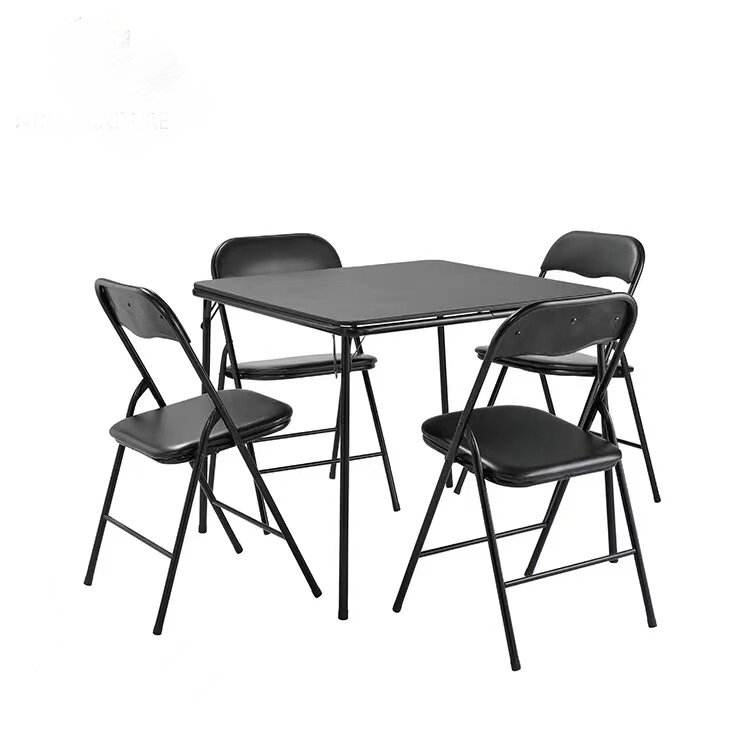
Folding furniture needs to combine convenient storage with dependable performance during everyday use. A table may be moved between meeting rooms, event spaces, and temporary work areas, while chairs may be folded, stacked, and unfolded repeatedly throughout their service life. For buyers sourcing Wholesale Folding Table And Chair products, the frame design deserves close attention because it affects stability, handling, and long-term usability. Understanding how the structure works can help procurement teams evaluate products more carefully before placing bulk orders.
The shape and arrangement of a furniture frame determine how loads are transferred from the tabletop or seat to the floor. Leg spacing, support placement, crossbars, and connection points all influence how the product behaves during use.
A folding table needs a support structure that keeps the tabletop properly positioned, while a folding chair requires a frame that supports the seat and backrest without unwanted movement. Manufacturers should consider these relationships during product development rather than evaluating individual components in isolation. Buyers can examine whether the assembled furniture stands evenly and whether its structural layout suits the intended application.
Folding furniture depends on moving connections that allow the legs or frame sections to change position. These joints must permit the intended movement while remaining secure when the product is opened for use.
Loose connections can affect stability, while poorly aligned components may make folding difficult. During manufacturing, attention should be given to joint alignment, fastener installation, hinge movement, and the engagement of locking mechanisms. For buyers, checking these details on a sample can provide useful information about assembly quality and ease of operation.
A folding mechanism is not complete simply because the furniture can open and close. The structure also needs to remain in its intended position during normal use.
When evaluating a Wholesale Folding Table And Chair product, buyers should check whether the locking components engage clearly and whether the frame can be folded without unnecessary force. Manufacturers can test repeated opening and closing to identify interference, abnormal looseness, or changes in alignment. The design should make the operating sequence understandable while reducing the likelihood of incomplete locking during setup.
Different furniture applications create different loading demands. A table used for paperwork may face different conditions from one intended for catering or group activities. Likewise, chair design needs to account for the intended user, seating arrangement, and normal movement during use.
Manufacturers should define the intended application and establish appropriate load and stability testing for each product. Buyers should request clear specifications and avoid assuming that products with similar dimensions have identical load capacities.
Useful points to confirm include:
These details create a clearer basis for comparing models and confirming purchasing requirements.
The frame finish affects the product's visual consistency, but it also needs to suit the intended environment and expected handling. Uneven coatings, exposed edges, rough areas, or poorly finished joints may affect product presentation and maintenance.
Manufacturers should inspect surface coverage, connection areas, and visible frame sections during production. Buyers can review finish uniformity and check for obvious defects, particularly when the furniture will be supplied to commercial customers who expect matching products across a complete order.
A well-made sample does not automatically guarantee that every unit in a wholesale shipment will have the same operating characteristics. Differences in frame dimensions, fastener installation, hinge alignment, or surface finish can become more noticeable across larger orders.
Manufacturers can improve consistency by maintaining clear assembly specifications, checking critical components during production, and inspecting finished furniture before packing. Buyers should confirm approved samples, product dimensions, color requirements, and packaging arrangements before mass production begins. These steps help create a shared reference for quality evaluation and repeat purchasing.
The value of Wholesale Folding Table And Chair products depends on how well the frame, joints, locking mechanism, materials, and finished assembly work together. A convenient folding design should not come at the expense of stability, and a strong frame should still allow practical handling and storage.
For overseas procurement teams, discussing intended use, load requirements, operating frequency, and inspection expectations with a manufacturer helps clarify which design is appropriate. By connecting structural engineering with repeatable manufacturing checks, manufacturers can supply folding furniture that better matches the practical requirements of commercial buyers.

Wuyi Qixing Machinery Technology Co., Ltd. is committed to providing high-quality, durable and environmentally friendly products for outdoor leisure and entertainment venues.
Further negotiation?
We are glad to hear from you.
* We promise never to disclose your privacy.

Building 3-4#, Wangzhai Village, Jiangnan Industrial District. Wangzhai Town, Wuyi, Jinhua City, Zhejiang, China.

+86-13967960360
+86-15258989007


© 2023 Wuyi Qixing Machinery Technology Co., Ltd.
Outdoor Leisure Products




 中文简体
中文简体 西班牙语
西班牙语 阿拉伯语
阿拉伯语
Contact Us